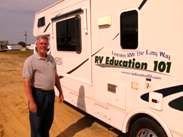
Harrells, NC – December 2010 -- RV Education 101, founded in 1999, announced the launch of a new RV consumer training site today. The URL is http://www.rvconsumer.com/. Mark Polk, founder and co-owner of RV Education 101 said, “We have worked on this RV consumer site for several months now, and are extremely excited to finally launch it.
Tagged as “The Ultimate RV Education Center” Polk says, “This site is a culmination of all of our RV training efforts over the past decade, and is a one stop RV training site for the entire RV consumer’s training needs. One day I realized that if I consolidated all of our RV training material into one RV training site, it would in fact be the premier RV education center.”
The RV training material Polk is referring to is his 18-RV instructional DVD’s, 13-published RV E-books, 3-published RV books, 4-RV online training programs, hundreds of published RV articles, RV product installation videos and RV product reviews.
Dawn Polk, co-owner and marketing director, said, “Our thought behind this new site was to organize the vast field of RV’s and RVing into six major categories and offer the RV consumer invaluable information in each of these areas. The six categories are: RV consumer training, RV consumer buying, RV consumer safety, RV consumer products, RV consumer articles and advice and last but certainly not least, enjoying your RV. To help promote our new site and to introduce our RV videos on demand online training program we are offering a free RV safety e-course to anybody that would like to take it. You can visit www.rvconsumer.com for more details on the free RV safety e-course.
Polk’s other RV educational sites are http://www.rveducation101.com/ and http://www.rvuniversity.com/. The primary focus of these RV training sites has been to educate RV owners on how to properly and safely use and maintain their RV, using visual and written training materials. RV Education 101 has helped educate more than a quarter of a million RV enthusiasts over the past decade.
For more information on these RV educational sites visit www.rvconsumer.com, http://www.rveducation101.com/
and http://www.rvuniversity.com/
xxx
Showing posts with label RV safety. Show all posts
RV Education 101 Announces Launch of New RV Consumer Site
Labels:
new rv,
rv 101,
rv consumer,
rv education,
rv information,
rv learning,
RV safety
RV Travel Safety & Security
The National Highway Traffic Safety Administration (NHTSA) reported that overall traffic fatalities at the end of 2009 reached the lowest level since 1954, declining for the 15th consecutive quarter. The projected data puts the highway death count at 33,963, down 8.9% from 37,261 in 2008.
That’s good news but, one death is too many.
Today I would like to discuss getting to your RV travel destination safely. Getting there can be half the fun, as the saying goes, if you take a few precautions to make your trip as safe as possible.
Trip Planning: The first step is to plan the trip you are taking. Travel guides, magazines, state tourism boards and Internet sites offer valuable information to help you plan your trip. Route your trip on a map or from an Internet trip planning website.
■ Trailer Life RV Trip Planning
■ Fuel Cost Calculator
■ Local Gas Prices in the USA
Always keep an atlas or maps in the RV or tow vehicle. Driving a motorhome or pulling a trailer can be stressful, especially if you don’t know the route you will be traveling. Using a GPS system can make traveling much less stressful.
I am including this short checklist to assist you in planning your RV trips.
■ Route your trip on a map or from an Internet trip planning website.
■ Plan your itinerary to include what campgrounds you will be staying at.
■ Give a family member or friend a copy of your itinerary and contact information.
■ Make campground reservations in advance especially during the busy travel season.
■ Limit your traveling to 350 miles a day or less. Not only will your trip be more enjoyable, but this will allow plenty of time to get set-up at the campground before it gets dark outside.
■ Make sure your emergency roadside service is up to date. If you don’t have one you should get one prior to leaving on your trip.
■ Conduct pre-trip checks for your RV.
■ Check and refill any medications you will need.
■ Be sure you have your credit cards, ATM card, checkbook and cell phone.
■ Check the weather conditions for where you will be traveling each day. Take a weather radio receiver with you. Don’t travel in bad weather or during high winds.
■ Take your address book and stamps.
■ Take emergency contact numbers.
■ Take a spare set of eyeglasses or reading glasses.
■ Take a spare set of keys.
■ Make sure you have all your owner’s manuals for the RV & warranty information.
■ If you’re under a doctor’s care take along a copy of your medical records. Make a list of all medications you are taking and keep it in your wallet or other safe place for quick reference.
■ Take passports (only if necessary) and check the expiration dates.
■ Double check that everything is loaded in the RV.
Pre-Trip Checks: Do you know what two of the most common repairs made on RV’s are? They are repairs to the steps and the TV antenna. Damage to RV steps and TV antennas occur frequently and can be costly to repair. The main reason for these frequent repairs is because you forget to do a walk around of the unit before leaving on a trip or leaving the campground. The good news is both of these common repairs can be avoided by following a simple “Pre-Trip Checklist” before heading out in your RV. Simple checks like checking your tires, lights, hitch work and other items all contribute to a safer, stress free trip. You should make these checks everyday before traveling.
RV Travel Security: For one minute, try to think the way a criminal would think. If you were at a rest stop looking for your next target or victim, what would you look for? Let’s pretend for a moment that you were going to target a vehicle. Which would be more appealing, a car whose owner stopped for a quick bathroom break or an expensive looking Type A motorhome, whose owners are out walking their dogs? I don’t have the mind of a criminal but this is an easy choice. That expensive looking RV probably has expensive contents inside like, jewelry, cameras, or a laptop computer. Okay, we have come to the conclusion that we, the RVers, are the prime target for the criminal mind, so we need to understand what we can do to protect ourselves and our personal belongings when traveling in our RV.
Don’t stay overnight at a rest stop. Rest stops attract criminals. If you stop at a rest stop it should only be for a short break and then back on the road. Lock the RV and take turns using the facilities, always leaving someone in or close to the RV. Always be on the look out for anything or anyone that looks suspicious. Keep your cell phone handy in case you need it and don’t ever open the door for anybody unless you know who is knocking.
Rest stops aren’t the only place you need to be concerned about. Every time you stop to refuel there are certain precautions you need to take. It’s easy to be vulnerable to a thief at a gas station or a truck stop. I have a bad habit of leaving my wallet on the console of our motorhome. The door isn’t locked and your spouse is taking advantage of the time to walk the dogs. This is how quick it can happen. Get in the habit of locking the doors whenever you or someone else is not physically in the RV.
Most robberies occur at night and most travel related robberie occur at rest stops, gas stations, convenience stores and ATM machines. Try to schedule most of your stops during daylight hours, and whenever you stop be aware of your surroundings. If something doesn’t look right leave.
Wal-Mart or other parking lots where you might stop to get a few hours of sleep can present security problems too. You should always park in a well lit area and the entry door of the RV should be facing where most of the activity is. A thief prefers to work where it is dark and where it is least likely to draw any attention. Close your curtains or blinds so it’s not possible for someone to look inside. Don’t open the door for anybody unless you know who it is. If it’s a security guard ask for identification before you open the door.
As much as we would like to believe that campgrounds are 100% safe and secure don’t let you guard down. You don’t need to be paranoid, just use some common sense. Don’t leave expensive equipment lying around unsecured. Vehicle tow bars, hitches, bicycles and other items need to be under lock and key.
Keep any valuables inside the RV secured and out of sight. It’s a good idea to purchase a small fire proof safe to store valuables and important paperwork in. The safe might protect your valuables from the hazards of a fire but it will still need to be stored in a secure, out of the way place, inside the RV.
Always lock the RV when you’re not physically at the campsite. Do not store valuable equipment in outside storage compartments. Believe it or not, a vast majority of RV’s use the same exact key as yours for outside storage compartments. If you store valuables, like golf clubs, fishing gear or tools in the outside compartments you may want to have the storage compartment locks changed.
Before you leave on a trip make sure your Emergency Roadside Service Plan is current. If you breakdown on the road try to pull off in as safe a place as possible and call for help immediately. Stay with the RV until help arrives.
It’s unfortunate that we live in a day and age where we need to take these added measures to protect ourselves. I don’t want you to feel like everybody you meet during your travels is a thief or has bad intentions. Just use common sense and be aware of what is going on around you.
On the Road: NHTSA reports ninety-five percent of crashes are caused by human error.
Relax, and take your time. Whenever I’m towing a trailer or driving a motorhome I apply these three guidelines:
■ Drive at a safe speed for the traffic and road conditions.
■ Always stay alert, know what is going on around you.
■ Anticipate driving situations before they happen.
Take plenty of breaks when you’re traveling. Stopping, stretching out and taking brief walks can revitalize you. Do not rush to get to your vacation destination. Driving too fast and for long periods of time can result in fatigue and falling asleep at the wheel. If you feel tired you should pull over and rest or change drivers. It’s a good idea to switch drivers every few hours. Keep a window cracked open to help you stay alert, and only eat light meals when you stop to eat.
Avoid driving or pulling your RV during bad weather and high winds. Because of the size and mass of RV’s it can be extremely dangerous to travel during periods of high winds. It’s better to get to your destination one day later, than to risk traveling in bad weather.
Limit your driving time to 5 or 6 hours a day (300 to 350 miles). Not only will you be more alert, but you will arrive at the campground with plenty of day light to get set up and settled in before it gets dark outside. This gives you a chance to unwind and get rested for another day of travel, and to enjoy some of the amenities the campground has to offer.
Always leave plenty of room between you and the vehicle in front of you. RV’s are much heavier than your automobile and require a longer braking distance to come to a stop. This alone will prevent accidents, especially during emergency braking. Driving at a safe speed also lowers your braking distance. Always use a supplemental braking system on the vehicle you are towing.
Cell phones are nice to have for emergencies, but they can distract the driver. Do not use a cell phone if you are driving. If you must make a call, have someone that is not driving do it for you.
Never drink and drive!
Goodyear offers a free Recreational Vehicle Tire and Care Guide. It has some great suggestions for all those miles of carefree driving.
Plan your trip, travel safe and smart and enjoy your RV experiences. Remember, getting there is half the fun!
For checklists on all of these topics and much more be sure and check out our bestselling Checklists for RVers ebook
Happy RV Learning,
Mark Polk
RV Education 101
RV University
RV Orientation
Go for the RV Gold
Follow us on FACEBOOK
RV Consumer
Braking Laws
Most U.S. States and Canadian Provinces have their own laws on the requirement for brakes on a towed trailer. The word trailer also applies to a vehicle being towed behind a motor home. These laws are normally based on the amount of weight being towed. Not only is it illegal to exceed these weight limits without brakes, but your insurance company may not cover you in the event of an accident involving a trailer with no braking system. The most important reason is for your safety and the safety of others.
For a complete list of braking laws for the U.S. and Canada go to http://www.roadmasterinc.com/products/braking/map.html
The brakes on a tow vehicle or motor home are designed by the vehicle manufacturer to stop the weight of that particular vehicle, not the additional weight being towed behind it. This additional weight adds a substantial increase to the distance required to stop safely.
Travel trailers and 5th wheels come equipped with electric brakes and RV dealers educate the RV consumer on the requirements for adding an electronic brake control to the tow vehicle. Some pop-ups are ordered with brakes and some without. Again, this is often times based on the braking laws for the state you live in. My advice is if you’re going to purchase a pop-up get one that has brakes.
The real culprit for disregarding braking laws is a motor home towing a vehicle behind it. Most people assume that because of the size of the motor home there is no need for a supplemental brake system on the towed vehicle and sometimes RV dealers fail to communicate the requirement for a supplemental braking system.
I for one was guilty of towing a vehicle without a braking system for quite some time. A close call, while driving through a major city during rush hour, suddenly educated me on how important it is. Another thing that surprises people is how much the vehicle they’re towing actually weighs. Take your towed vehicle to a set of scales and have it weighed. Make sure it has everything in it that will be in it when you are towing it. After you weigh it double check to make sure the receiver on the motor home is rated to tow that amount of weight and that you aren’t exceeding any of the motor home weight ratings like the Gross Combined Weight Rating (GCWR). The GCWR is the maximum permissible weight of the fully loaded motor home and the fully loaded towed vehicle combined. Most RV chassis manufacturers base their GCWR on the assumption that a supplemental brake system is being used.
Regardless of the brake system that best suits your individual needs the important thing is that you have one. There are many reasons to have a braking system on your towed vehicle.
1) It’s the law
2) It can void your vehicle warranty
3) It can void your insurance
4) It will reduce wear and tear on RV brakes and other components
5) Liability
But, most importantly it SAFELY reduces the stopping distance and helps to protect you, your loved ones and the safety of others.
Happy RV Learning,
Mark Polk
RV Education 101
RV University
RV Orientation
Go for the RV Gold
Follow us on FACEBOOK
RV Consumer
Labels:
rv consumer,
rv education,
RV safety,
towing laws
Tips to Increase Engine Life
Today we’re going to talk about some easy ways to increase the life of your tow vehicle or motorhome’s engine. Actually there are many ways to to increase engine life in a vehicle, but I want to narrow the list to what I consider the most important. When all you hear every day is how poorly the economy is doing, it only makes sense to buckle down and take better care of what you already own.
A little bit of preventive maintenance (PM) now can pay big dividends in the long run. What’s that old saying? An ounce of prevention is worth a pound of cure! So, what can we do to extend the life of your tow vehicle, motorhome, or your automobile engine? Let’s take a look.
■Routine Oil and Oil Filter Changes
This is number one on my list. I have known people who I think change their engine oil and filter more frequently than it is needed, but it is usually the other way around. You should follow the vehicle manufacturer’s guidelines for changing the engine oil and filter. If at all possible try to change the oil and oil filter prior to any long-term storage. Acids accumulate in used oil and can corrode the engine bearings. Don’t forget the generator oil and filter, too.
■Help your Engine Breathe
A dirty or clogged air filter can rob life from your engine. When the engine can breathe properly it not only lasts longer but is more fuel efficient. Recommendations for checking and replacing air filters are normally based on driving conditions. It only takes a couple of minutes to check the air filter. I check mine when I change the engine oil, and the filter gets replaced if it’s dirty.
■Pay Attention to Service Intervals
The manufacturer recommends service intervals for a reason. You guessed it, to maximize efficiency and extend the life of the engine. Whether it’s a diesel or gasoline engine it’s important that you pay attention to, and follow these recommended service intervals. If you don’t perform your own routine maintenance, find a local dealership or repair shop you can trust and put the vehicle on a routine service schedule.
■Keep it Running Cool:
Just as clean engine oil lubricates moving parts and extends the engine’s life, clean engine antifreeze helps the major components of the engine stay cool and extends the engine’s life. Follow the engine manufacturer’s guidelines for flushing and replacing the coolant (make sure to use the proper type of coolant for the engine). Every time you lift the hood, check the coolant level and inspect coolant hoses for damage. Coolant hoses deteriorate from the inside out. Inspect all hoses for wear, cracks, soft spots, brittle areas and leaks. Replace any damaged hoses or clamps as required.
■Perform Pre-Trip Checks:
Before moving the tow vehicle or RV, make the following checks concerning the engine. Check all fluid levels in the power steering resevoir, engine coolant, engine oil, windshield washer and brake fluid. Check the transmission fluid while you are at it. Consult your vehicle owner’s manual for proper procedures to check and add fluids. Start the engine, allow it to reach operating temperature and check for proper readings on all gauges. Look under the vehicle for signs of leaks. Have any leaks checked out and repaired before using the vehicle.
■Driving is Important, Too:
Smart drivers can extend the life of their vehicle engine. Watching RPMs, knowing when to shift gears and monitoring gauges all contribute to extending the life of your engine. Always warm an engine up before driving. Don’t race a cold engine; accelerate slowly until the engine is up to operating temperature. Avoid quick starts and fast stops whenever possible. Always monitor your gauges. If a gauge is reading outside of the normal operating range, pull over when it is safe and have it checked/repaired.
■Proper Storage Procedures:
Proper storage procedures can extend the life of your engine, whereas improper procedures can harm the life of your engine. I already mentioned that changing the oil and oil filter prior to long-term storage (say three or more months) can help your engine. Acids accumulate in used oil and can corrode the engine bearings. Start the engine periodically when the motorhome is in storage and run it until it reaches operating temperature. Fill the fuel tank and add a fuel preservative to the tank. Run the engine and generator long enough to get the preservative through the fuel system. Protect the engine compartment from critters. Squirrels and mice love to chew on plastic, rubber and anything else they can find, and a vehicle engine compartment makes a safe and cozy winter home. If the motorhome is stored outside I recommend starting the engine more often to deter these critters from calling it home.
If the RV has a generator exercise it on a regular basis. When you run the generator make sure there is at least a ½-rated load on it. Check your generator owner’s manual for instructions on exercising it.
I mentioned earlier that there are many other factors that can extend the life of your engine, but I think these are some of the most important. If any one of these items is not properly maintained it could end up costing you thousands of dollars in repairs. Maintaining your vehicles engine is not that difficult to do, and in times of uncertainty it is what I would call cheap insurance.
Happy Camping.
Mark Polk
RV Education 101
RV University
RV Orientation
Go for the RV Gold
Who is that driving the motorhome?
Over the weekend we started planning for an RV trip we are taking later this summer. It's about 6,000 miles roundtrip. We are on somewhat of a timeline and I wanted an idea on average of how many miles we would travel each day, based on our schedule.
It seems like more often than not we are on a tight schedule, forcing us to put in more miles per day than I would like. I want this trip to be more leisurely when it comes to how many hours you are behind the wheel each day.
Admittedly I am one of those people who likes to do all of the driving myself. I just feel better if I know I am behind the wheel. I know my wife, Dawn, is a competent driver (she even has her CDL) but I still prefer to do the driving. Don't get me wrong, I think it is extremely important that both individuals are capable of driving or towing the RV. You never know when your wife or husband will need to drive the RV and they should feel comfortable and confident in doing so.
As we were planning the trip it brought back a memory of a past trip we took in the RV. We were stopped in traffic because of an accident, and had sat in the same spot without moving for at least 30 minutes. I told Dawn that I was going to run back and use the bathroom and if traffic started moving to just get behind the wheel and drive. The boys were in the back bedroom playing X Box.
The motorhome started moving about the same time that I came out of the bathroom. Both boys looked up at me with their eyes wide open and my older son said, "If you're back here with us who's driving the motorhome?" My youngest son (Dawn's stepson), who was about 8 at the time leaped up and ran to the front of the motorhome and said, "Dawn just pull over as soon as you can and let dad drive."
The boys never saw Dawn drive the motorhome and just assumed she couldn't or shouldn't be driving it. At that point I made a mental note to myself to one day produce a driving DVD to help teach people who don't drive the RV how to do it. It took a while but eventually we produced our Drive your Motorhome Like a Pro DVD
Mark Polk
RV Education 101
RV University
Facebook
It seems like more often than not we are on a tight schedule, forcing us to put in more miles per day than I would like. I want this trip to be more leisurely when it comes to how many hours you are behind the wheel each day.
Admittedly I am one of those people who likes to do all of the driving myself. I just feel better if I know I am behind the wheel. I know my wife, Dawn, is a competent driver (she even has her CDL) but I still prefer to do the driving. Don't get me wrong, I think it is extremely important that both individuals are capable of driving or towing the RV. You never know when your wife or husband will need to drive the RV and they should feel comfortable and confident in doing so.
As we were planning the trip it brought back a memory of a past trip we took in the RV. We were stopped in traffic because of an accident, and had sat in the same spot without moving for at least 30 minutes. I told Dawn that I was going to run back and use the bathroom and if traffic started moving to just get behind the wheel and drive. The boys were in the back bedroom playing X Box.
The motorhome started moving about the same time that I came out of the bathroom. Both boys looked up at me with their eyes wide open and my older son said, "If you're back here with us who's driving the motorhome?" My youngest son (Dawn's stepson), who was about 8 at the time leaped up and ran to the front of the motorhome and said, "Dawn just pull over as soon as you can and let dad drive."
The boys never saw Dawn drive the motorhome and just assumed she couldn't or shouldn't be driving it. At that point I made a mental note to myself to one day produce a driving DVD to help teach people who don't drive the RV how to do it. It took a while but eventually we produced our Drive your Motorhome Like a Pro DVD
Mark Polk
RV Education 101
RV University
What's your RV Emergency Escape Plan?

When we plan a trip in our RV we tend to think about all of the good aspects of the upcoming adventure. Where we are going, what we’ll do when we get there, and all of the things we will see and experience along the way. What we don’t really think about is what if something happens during the trip and everybody needs to exit the RV in a hurry. What if there is a fire? What if the entry door is blocked and you can’t get out. What’s the plan? Is there a plan?
I don’t want to worry anybody. My intent is to bring awareness to the possibility that something like this could happen, so you can discuss it and be prepared in the event of an emergency. An RV emergency escape plan is just one of those things lots of folks don’t think about.
For starters, the National Fire Protection Association (NFPA) requires that RV’s have emergency escape windows. Make sure that everybody(old enough) traveling with you in the RV knows where the emergency escape window is located and how to use it. It’s a good idea to practice using it so you are familiar with how to get out of the RV in case of an emergency. Consider elderly persons and small children. Can they exit the emergency window without assistance, and if not what is the plan.
Here are some more important considerations when formulating your escape plan:
* In the event of an emergency the mission is to get everybody out of the RV quickly and in an orderly fashion.
*You should have an emergency escape plan for the front of the RV and the rear of the RV.
* Time is your biggest enemy if there is a fire. An RV can fill with smoke in as little as one minute.
* Design an escape plan specific to the needs of the individuals in the RV.
* Sketch your plan on paper and indicate which windows and doors can be used to escape. Review the plan with everybody in the RV. Make sure each adult understands their duties when it comes to assisting others.
* Make sure everybody knows where the emergency escape window is located and how to use it.
* Make sure everybody knows how to use other windows and door latches in the RV, before there is an emergency.
* Practice your escape plan so everybody is familiar with how to get out of the RV in case of an emergency.
* If possible, designate a meeting place outside where everybody will meet immediately after exiting the RV so you can get accountability.
* When everybody is safely out of the RV call 911 for help.
* Never re-enter a burning RV!
Most importantly, do not risk your personal safety, or the safety of others, attempting to put a fire out. The first step is to get everybody out of the RV and away from the fire safely. Have somebody call 911 for help, and if you can’t extinguish the fire within the first minute or so let the professionals handle it.
For more information on RV Safety be sure to check out our RV Safety Features, Tip & Tricks Ebook
Happy Camping,
Mark Polk
Where's the Spare
Why don’t some RV manufacturers include a spare tire with a new RV? Is it a liability issue or a cost issue? I have heard both sides of the story over the years, and it usually depends on what type of a RV you are talking about.
I have owned three towable RV’s and two motorized RV’s. Two of the towable RV’s came with spare tires when I purchased them and I ordered a spare tire as an option on our Class C motorhome, but I could not get a spare for our Class A motorhome.
It seems ridiculous that you buy an RV, designed for traveling all over the country, and the one thing not included is a spare tire. Let’s try to find out why there’s no spare!
It has been rumored that many years ago an RV owner got hurt while changing a tire on his motorhome and that he sued the RV manufacturer. This is supposedly why many motorhome manufacturers opt not to include a spare tire, especially on larger motorhomes.
Admittedly changing a spare tire on a large motorhome is not the same as changing a tire on your automobile. From a liability standpoint the argument is because of the size of the RV and the weight of the tire and wheel it can be dangerous for an individual to attempt changing a tire. Plus you would need to carry some special type of equipment to safely and properly change a tire. I would have to agree, but why not include a spare (without a jack or the other necessary equipment) and have a mandatory warning label stating the dangers of changing a tire along with a recommendation to use a professional road side tire service to change the tire for the owner.
Here is what some RV and chassis manufacturers have to say:
Why doesn't the RV come with a spare tire?
The combined weight of the tire and wheel is approximately 110 pounds. Even if you feel comfortable lifting that amount of weight, other variables pose a problem when it comes to changing an RV tire. You may find yourself on the side of the road in a confined situation, or during the nighttime when it is raining.
Jacking up the side of the RV would be difficult. Leveling jacks are not designed to lift the entire wheel off the ground to change a tire. To change a flat RV tire, it would be necessary to store the correct jacks and jack stands for safety. The next hurdle would be the lug nuts, which are torqued to 500 pounds and difficult to remove. Once removed, and while reinstalling, a tool to properly retorque the lug nuts would be needed. All these necessary tools, combined with the actual spare tire, would take up a considerable amount of space and add additional weight to the RV. Call roadside assistance for tire repair and save yourself the aggravation.
My vehicle doesn’t include a spare tire. Where can I get one and where can I store it?
Most larger motorhomes don't provide a spare for several reasons. Generally, the wheel assembly is too cumbersome and heavy for one person to change alone without risking injury. We'd recommend that, in the case of a flat, you enlist the help of a roadside service crew to fix your flat tire. If you do decide to obtain a spare wheel assembly, contact your dealer for details on ordering one and the proper way to store it.
Now that we know why some motorhome manufacturers don’t include spares why don’t some of the towable manufacturers include spares?
This is where the cost issue comes into play. RV manufacturers look at every penny going in to manufacturing the RV. Not including a spare in the base price of the RV can save money, so they list the spare tire as optional. What this means is when the RV dealer orders the unit they can add a spare or not add a spare. If a dealer is trying to bring a unit in based on price point they limit the options included on the unit. When I was a RV sales manager I included a spare tire on every towable unit just because it made sense and it really wasn’t that expensive.
You still need to consider the safety aspects of changing a tire on a trailer. Even though it’s smaller and lighter than a motorhome tire you still need equipment like a jack, jack stands, lug wrench and torque wrench. In addition to the equipment required, you need to have a basic understanding of how to safely and properly jack the trailer up. But again, if you have a spare you can always call a roadside service to change it for you. If you don’t have a spare you may be stranded in some out of the way place until the tire can be ordered and come in. This could take a couple of days, or longer.
That brings me to how this article came about. We are planning a cross country RV trip this summer and I refuse to go without a spare tire. Our motorhome has 22.5 inch tires with 8 lug rims. When I tried to locate a tire and rim it was difficult to find one. I’m sure I could order one from the manufacturer, but I would be afraid to know what the cost is. We have a good roadside assistance plan so what I decided to do was to just buy the tire itself and if I have a flat the roadside tire service can mount the new tire on the rim. It is less weight to carry and it eliminates the possibility of delays due to ordering and waiting for a tire to come in, if it isn’t in stock.
Regardless of whether or not your RV came with a spare I think it’s a good idea to get one, and I think for safety reasons you are better off having a roadside service plan that will change the tire for you.
What do you think?
Mark Polk
RV Education 101
RV University
Carbon Monoxide RV Safety Reminder
Every year, around this time, I like to remind people about the dangers of carbon monoxide gas. Whether in your home or your RV, when you fire up the furnace and bring out the portable heaters to help stay warm, there is the threat of carbon monoxide poisoning.
Carbon monoxide gas is invisible, odorless, and deadly! It is produced by the partial combustion of solid, liquid and gaseous fuels. This includes gasoline, propane, natural gas, oil, wood, & coal. It is extremely serious when combustion by-products are not vented outside. Carbon Monoxide is the number one cause of poisoning deaths each year.
Let’s take a look at what we can do to prevent the danger of carbon monoxide poisoning.
In RV’s Carbon Monoxide Gas usually results from:
* Exhaust leaks from either a vehicle engine or a generator.
* Improper use of portable gas powered heaters.
* Someone else’s vehicle or generator when camping in close quarters.
* Malfunctioning or unvented LP gas appliances
First of all, if your RV doesn’t have a carbon monoxide detector you need to purchase a battery operated carbon monoxide detector designed for use in RV’s. Test the carbon monoxide detector every time you use the RV. Replace the carbon monoxide detector batteries when you change clocks for daylight savings time.
* Inspect the generator exhaust system before using the generator, every time.
* Avoid leaving windows down and roof vents open when in close proximity to vehicle and/or generator exhaust.
* Follow all directions and safety cautions and warnings when operating gas powered heaters.
* If you use a portable generator direct the exhaust away from the camping area.
* Never use the range burners or oven to heat the RV!
* When cooking with the range burners use the range fan & leave a window cracked open for fresh air and ventilation.
Teach everybody how to recognize carbon monoxide symptoms. Carbon monoxide symptoms are similar to flu symptoms, but without the fever.
Carbon Monoxide symptoms include:
* Dizziness
* Vomiting
* Nausea
* Muscular twitching
* Intense headache
* Throbbing in the temples
* Weakness and sleepiness
* Inability to think coherently
* Vomiting
* Nausea
* Muscular twitching
* Intense headache
* Throbbing in the temples
* Weakness and sleepiness
* Inability to think coherently
If you or anyone else experiences any of these symptoms get to fresh air immediately. If the symptoms persist seek medical attention. Shut the vehicle or generator down and do not operate it until it has been inspected and repaired by a professional.
A basic understanding of what carbon monoxide gas is, how to avoid exposure, and what the symptoms are can save lives. Make sure everybody in your home and/or RV is aware of carbon monoxide poisoning.
For more in-depth information on RV safety check out our RV Safety DVD.
Happy & Safe Winter Camping,
Mark J. Polk
Preventive Maintenance Checks for an RV Generator
Preventive Maintenance (PM) is maintenance the owner can perform on your RV before a problem exists. These checks are designed to prevent or identify potential problems that could lead to mechanical breakdown, malfunction or failure of a component or system on your RV. Preventive Maintenance consists of cleaning, inspecting, lubricating, adjusting and servicing your RV.
Here are some PM checks you can perform on a typical RV generator. In addition to these checks you should always follow the maintenance schedule and guidelines that came with your specific generator set.
Note: These PM checks are for a gasoline fueled generator. There are diesel propane fueled generators too. Some of these checks apply to all types, but some don’t. Consult your generator owner’s manual for maintenance checks and services for your specific generator.
1) Always check the oil level and the exhaust system prior to starting the generator. Starting and running a generator that is low on oil can result in costly damage to the generator’s engine. Add oil as required. Check your owner manual for the type of oil to use. A damaged exhaust system can result in carbon monoxide gas getting inside the RV. Always inspect the entire generator exhaust system prior to starting the generator. Never operate a generator with a damaged exhaust system!
2)Keep the generator set and the compartment it is housed in clean. You can use compressed air to assist in cleaning out the generator compartment and a clean shop rag to clean the generator set. While you are cleaning the generator check all electrical connectors for secure connections.
Note: always wear safety glasses when using compressed air.
3)Check all of the filters on the generator. A typical generator may have an air filter, fuel filter and oil filter. Check your generator owner manual for the types of filters your generator has and where they are located. Maintenance checks and services for a generator are based on hours of operation. You need to monitor the hour meter on your generator set for all maintenance intervals.
a)Check the air filter for cleanliness. You can remove it and inspect the fins on the back for signs of dirt or debris. You can tap the air filter on a flat surface to help remove some of the dirt and debris. Change a dirty filter, or change it at prescribed intervals. Inspect the air filter more often in dusty conditions.
b)The fuel filter will typically be an in-line type filter. Over time it filters out and collects enough debris that it can interfere with the flow of fuel. Check and replace the fuel filter at prescribed intervals.
c)We’ll talk about the oil filter in just a minute.
4)Change the oil and oil filter (if equipped). This is perhaps the most important PM Service you can perform on your generator to ensure years of reliable service. Change the oil and replace the oil filter at the recommended intervals. It’s really quite simple to do. Your generator owner’s manual will usually describe the steps to follow. If you don’t feel comfortable changing the oil and filter have an authorized RV service center do it for you.
5)Replace the spark plugs at recommended intervals. If you ever replaced the spark plugs in a vehicle you can replace the plugs in the generator, unless due to the constraints of the generator compartment you can’t access the spark plugs. In this case you may want to let an authorized RV service center do it for you. If you decide to do it yourself check your generator owner manual for the correct type of plug to use and double check the spark plug gap before installing the plugs. Do not over tighten spark plugs!
6)Exercise the generator. There are several reasons why you should start and exercise the generator on a regular basis. Moisture build up can cause damage to your generator. When you exercise your generator it heats up the generator windings and eliminates this moisture build up. This monthly exercise regime also lubricates all of the engine seals and components and helps to prevent carbon build up. So, what exactly do I mean when I say exercise your generator? For a gasoline generator I mean that you start and run the generator with at least a 50 % load, for at least two hours every month. It is extremely important that you run it with this minimum rated load. Generators are designed to run with a load placed on them. It’s always better to let your generator run for longer time periods than it is for short time periods. Check your generator owner’s manual for load ratings specific to your unit. Always try to avoid starting or stopping a generator when there is a 120 volt device or appliance turned on.
7)Add a fuel stabilizer during periods of storage or non-use. If it’s a motorhome add a fuel stabilizer to the motorhomes gas tank and run the generator long enough for the stabilizer to get through the fuel system. This will help prevent gas related problems on carbureted generators, like not starting or surging. These are problems you don’t need. Fuel stabilizers can protect the fuel system for up to six months, but keep in mind the importance to exercise the generator when possible.
Well there you have it. Follow these simple steps, and the maintenance and service instructions in the generator owner’s manual, and you can get years of reliable service from your generator set.
A couple of additional tips for generator maintenance are to keep the battery that is used to start the generator maintained, and when running the generator monitor the AC voltage and frequency output with some type of digital plug in meter. I recommend one that can test campground polarity, measure AC line voltage and AC frequency. Frequency is the number of times that electricity alternates per second. U.S. appliances are designed to operate at 60 cycles per second, or 60 hertz.
When you use your generator the governor in the generator must hold the speed constant at, or close to 60 hertz from no load on the generator to a full load. Depending on the load placed on the generator, AC voltage can range from 105 to 135 volts and the frequency can range from 58 to 63 hertz. Anything outside of these parameters can cause problems for your RV electrical system and/or generator set. The meter will let you know when the generator is not operating within the proper ranges and you can have it checked out and repaired before any damage occurs.
Happy Camping,
Mark J. Polk
RV Education 101
RV University
copyright 2009 by Mark Polk owner of RV Education 101
RV Fire Safety...What's Your Plan?
Did you know that there are close to 20,000 reported RV fires each year? Do you know what to do in the event of a fire in or around your RV? If you said no don’t feel bad, because there are a lot of other people who don’t know either. Over 25% of RV fires are caused by shorts in the 12-volt electrical system. Not only do you need a fire extinguisher, but you need to inspect it before each trip to make sure it is charged. Look to see if the arrow is pointing in the green area in the sight gauge. If it reads empty or needs charging replace it or have it recharged immediately. If it’s a dry powder type fire extinguisher the arrow pointing in the green doesn’t always guarantee that it will work.Read Mark's in depth article about Fire safety: http://www.rvuniversity.com/article.php/20070514105149937
Copyright Mark J. Polk, owner RV Education 101
Labels:
fire extinguisher,
RV Fires,
RV safety
Defensive Driving = Smart Traveling
Forty thousand people in the United States die each year on the road!
Avoid driving or pulling your RV during bad weather and high winds. Because of the size and mass of RV’s it can be extremely dangerous to travel during periods of high winds. It’s better to get to your destination one day later, than to risk traveling in bad weather.
Eventually you will have to pass another vehicle in your RV. It's not difficult to pass but with a large RV it requires more space and time than the average automobile. Make sure you have plenty of room and use your turn signals to change lanes. Accelerate until you are past the other vehicle and you can see both of their headlights in your side mirror. Signal again to return to the other lane and pull back in. Maintain your speed ahead of the vehicle you just passed.
Read Mark's in depth RV safe driving article:
http://www.rvuniversity.com/article.php/20070510143232128
Copyright 2007 by Mark Polk, owner of RV Education 101
Avoid driving or pulling your RV during bad weather and high winds. Because of the size and mass of RV’s it can be extremely dangerous to travel during periods of high winds. It’s better to get to your destination one day later, than to risk traveling in bad weather.
Eventually you will have to pass another vehicle in your RV. It's not difficult to pass but with a large RV it requires more space and time than the average automobile. Make sure you have plenty of room and use your turn signals to change lanes. Accelerate until you are past the other vehicle and you can see both of their headlights in your side mirror. Signal again to return to the other lane and pull back in. Maintain your speed ahead of the vehicle you just passed.Read Mark's in depth RV safe driving article:
http://www.rvuniversity.com/article.php/20070510143232128
Copyright 2007 by Mark Polk, owner of RV Education 101
Labels:
rv driving,
RV safety,
rv travel
Be Prepared for Bad Weather RVing
Something many RVers do not take into consideration with the freedom to roam is the weather conditions where you are traveling to, or spending the night. RV's are great, but they are not safe in severe weather, like lightning and thunderstorms with high winds, tornadoes and hurricanes.
Every RVer should own a weather radio receiver. Prices for receivers can range anywhere from $25 to $200 depending on the quality of the receiver and the features it has to offer. We actually have two weather radio receivers. Both are from The Weather Channel® Stormtracker™ series by Vector. We leave the Compact Storm Tracker in the RV at all times. It’s a TV with a five inch screen, an AM-FM radio, emergency weather radio, cell phone charger and flashlight all in one. When we arrive at our destination we set it in the ‘Weather’ position and tune in to the NOAA station with the strongest signal in that area. Then, by leaving the Storm Tracker in the alert/lock mode 24/7, when an all-hazard emergency or weather alert is broadcast by NOAA, the Storm Tracker sounds an audible alert to notify us that a message is pending.
We also have a handheld Stormtracker model that we can use when we are away from the campground. It’s perfect for hiking, riding four-wheelers, boating and many other uses. Both models work off of 12 volt DC, 120 volt AC and dry cell batteries. There is also a back-up power system, furnished by built in rechargeable batteries. The rechargeable, battery is a secondary power source for emergency use when the battery, 12 volt DC power or 120 volts AC are not available. If the power goes out for a long period of time, and all of battery sources have been depleted, both radios have a hand crank that can be used to recharge the batteries and continue to operate the weather radio, flashlight and cell phone charging port. When you get back home, you can use the weather radio receiver in your house.For more information on the NOAA Weather Radio visit their website at www.nws.noaa.gov/
Read Mark's in depth article on bad weather RVing:
http://www.rvuniversity.com/article.php/20070510123918354
Copyright 2007 by Mark J. Polk owner rveducation101.com
Labels:
rv planning,
RV safety,
rv travel,
rv weather
Are You Braking the Law?
A topic that is sometimes overlooked, and seldom talked about is supplemental braking systems. It’s not about what supplemental braking system you have, it’s the fact that you have one!
One requirement for towing a trailer is that the trailer must have a braking system that works in conjunction with the tow vehicle brakes. Why should this requirement be any different for a motorhome towing a vehicle? In reality its not, but most people just assume you don’t need a supplemental braking system for the vehicle you’re towing. Some reasons for this assumption are:
1) Because of the size of the motorhome there is no need for a supplemental brake system on the tow vehicle.
2) People assume the vehicle they are towing is much lighter than it really is.
3) Braking laws are not always enforced by individual U.S. states and Canadian provinces.
4) Nobody took the time to educate the RV consumer on the requirement for a supplemental braking system.
Regardless of the type or model you choose, being able to stop completely, in less time and a shorter distance, will give you an added sense of safety whenever you’re towing a vehicle. And it’s the law in most cases. Most importantly, a supplemental braking system SAFELY reduces the stopping distance and helps to protect you, your loved ones and the safety of others.
Read Mark's in-depth article on supplemental braking systems:
http://www.rvuniversity.com/article.php/20070510084958709
Copyright 2007 by Mark J. Polk, owner of RV Education 101
One requirement for towing a trailer is that the trailer must have a braking system that works in conjunction with the tow vehicle brakes. Why should this requirement be any different for a motorhome towing a vehicle? In reality its not, but most people just assume you don’t need a supplemental braking system for the vehicle you’re towing. Some reasons for this assumption are:
1) Because of the size of the motorhome there is no need for a supplemental brake system on the tow vehicle.2) People assume the vehicle they are towing is much lighter than it really is.
3) Braking laws are not always enforced by individual U.S. states and Canadian provinces.
4) Nobody took the time to educate the RV consumer on the requirement for a supplemental braking system.
Regardless of the type or model you choose, being able to stop completely, in less time and a shorter distance, will give you an added sense of safety whenever you’re towing a vehicle. And it’s the law in most cases. Most importantly, a supplemental braking system SAFELY reduces the stopping distance and helps to protect you, your loved ones and the safety of others.
Read Mark's in-depth article on supplemental braking systems:
http://www.rvuniversity.com/article.php/20070510084958709
Copyright 2007 by Mark J. Polk, owner of RV Education 101
Subscribe to:
Posts (Atom)